When Worlds Split: A Play Therapist Role in Divorce Transitions
Description
Children who are often caught in the throes of their caregivers divorce experience emotional, behavioral, and relational challenges that require sensitive, developmentally appropriate interventions. Clinicians experience a parallel process becoming entangled with their child clients who are in the middle of a high conflict divorce which pose unique challenges clinically and ethically. Many times Clinicians are placed in the crossfire between parents, courts and children making it difficult to manage alliances, navigate the legal processes, and maintain neutrality.
This full-day interactive workshop is designed to deepen play therapists, counselors, social workers, and mental health professionals working with children impacted by contentious custody battles which often involve maltreatment allegations, and coercive control dynamics.
Deepen your understanding of legal and ethical responsibilities while equipping yourself with practical play therapy interventions which are effective and developmentally appropriate. An integrative approach that will work through a combination of experiential learning, case studies, and evidence-based interventions. Participants will gain hands-on strategies for creating therapeutic safety, navigating alliance issues, setting appropriate boundaries with parents, and documenting play therapy work for legal settings. Participants will leave with language for explaining their role to parents, strategies for responding to subpoenas or attorney requests, and a deeper understanding of the intersection between play therapy, attachment disruption, and family systems under stress. documenting in a legally sound manner, and setting boundaries with high-conflict parents.
This workshop will help clinicians reduce risk, increase competence in court-involved cases, and offer grounded, ethical therapeutic services to children experiencing the emotional toll of parental conflict.
Learning Objectives
Identify their scope of practice and boundaries to courts, attorneys and parents.
Discuss the impact of parental separation and divorce on children
Describe the continuum of parental separation in play therapy from mild estrangement to alienation.
Discuss ways to maintain neutrality, manage triangulation and avoid being in the middle of conflict
Demonstrate at least 3 play therapy interventions to help children process conflict, anxiety and divided loyalty.
Identify 3 ethical pitfalls play therapists face in high conflict cases.
Presenter
Danyale Weems, LCSW, RPT-S™
Danyale Weems is the founder of Waves Counseling in Carrollton, Georgia, where she has dedicated over 17 years to helping children, teens, families, and adults navigate life’s transitions. She earned her Bachelor’s degree in Criminal Justice from the University of Central Florida (2001) and her Master’s in Social Work from Florida State University (2008). A Licensed Clinical Social Worker, Danyale serves as a Supervisor for Social Workers and Play Therapists in training and is an EMDR Approved Consultant, guiding clinicians in trauma-informed and experiential approaches to healing.
Danyale is no stranger to the Alabama Association for Play Therapy, having presented multiple breakout sessions over the years. Her passion for helping families through change—especially in the context of divorce and relational transitions—shines through her engaging and practical teaching style. She brings a wealth of experience, insight, and heart to every training she leads.
Schedule
Registration
8:00-8:30
Morning Session Part I
8:30-10:00
Morning Break
10:00-10:15
Morning Session Part II
10:15-12:00
Lunch On Your Own
12:00-1:00
Afternoon Session Part I
1:00-2:30
Afternoon Break
2:30-2:45
Afternoon Session II
2:45-4:00
All times are CST
Continuing Education Credit
Six Contact Hours will be awarded for a full day of attendance.
Counselors:Alabama Association for Play Therapy (AAPT) has been approved by NBCC as an Approved Continuing Education Provider, ACEP No. 6211. Programs that do not qualify for NBCC credit are identified. Alabama Association for Play Therapy is solely responsible for all aspects of the programs.
Marriage and Family Therapists: The Alabama Board of Examiners in Marriage and Family Therapy (ABEMFT) automatically approves NBCC-approved courses for CE credit.
Play Therapists: AAPT is approved by the Association for Play Therapy (APT) to offer continuing education specific to play therapy. APT Approved Provider No. 98-045.
Social Workers: AAPT is approved by the Alabama State Board of Social Work Examiners (ASBSWE) to offer continuing education to social workers. ASBSWE Provider No. 0284.
A discount of $10.00 per registrant for groups of 3 or more registering together. Email the Treasurer (treasurer@alabamaplaytherapy.org) to complete a Group Registration. Credit Cards are accepted if registering online. No purchase orders accepted.
Scholarships
Scholarships to attend the AAPT workshop will be offered to full-time students who volunteer to be available Thursday evening, January 22nd, and all day Friday, January 23rd, to assist with the conference. Volunteer duties may involve working registration, assisting with setup before the event, cleaning up after the event, selling books for the presenter, and preparing materials for the workshop. Students interested in volunteering for the event should contact Hannah Finley at studentrep@alabamaplaytherapy.org and submit proof of enrollment in a counseling or related program (SW, MFT, etc).
Registrants canceling up to 48 hours before a workshop will receive a tuition refund less a $20 administrative fee (per day). All requests must be made in writing or by email. No refunds will be issued for any reason after January 21, 2026. In the unlikely event the workshop cannot be held, registrants will receive complimentary admission to a rescheduled workshop or a full value voucher, good for one year, for a future workshop.
Membership Information
To join the Association for Play Therapy, click here.
Sign up to receive emails from AAPT so you can stay up-to-date with all the news and announcements from AAPT!
Attendees will be able to select either one-day (Friday only or Saturday only) or two-day (Friday and Saturday) registration.
Conference Schedule
All times are CST
Friday, June 20, 2025 (6 contact hours)
8:00-8:30
Registration
8:30-11:45
Dalena Dillman Taylor- Adlerian Play Therapy and Interpersonal Neurobiology
11:45-1:00
Lunch on your own (AAPT Member Meeting – 12:45-1:00 – All are welcome!)
1:00-4:15
Dalena Dillman Taylor – Attachment-Based Play Therapy for Trauma, Behavioral & Sensory Challenges cont’d
8:00-5:00
Exhibits Tables Open
Saturday, June 21, 2025 (6 contact hours)
8:00-8:30
Registration
8:30-11:45
Dalena Dillman Taylor- Playing with Parents: Conducting Parent Consultations with the Brain in Mind
11:45-1:00
Lunch on your own
1:00-4:15
Pre-selected Breakout Sessions
8:00-4:45
Exhibits Tables Open
Registration Information
Early Bird (Until May 30th)
Regular & Onsite
Member 2 Day- $250
Member 2 Day- $350
Member 1 Day- $150
Member 1 Day- $250
Non Member 2 Day- $325
Non Member 2 Day- $425
Non Member 1 Day- $225
Non Member 1 Day- $325
Student 2 Day- $200
Student 2 Day- $300
Student 1 Day- $100
Student 1 Day- $200
Groups of three or more must register together to receive the $10 off per person. Payment for all group members must be made in the same payment transaction. To receive the group rate email ceandregistration@alabamaplaytherapy.org
Cancellations:
Registrants canceling up to 48 hours before the conference will receive a tuition refund less a $20 administrative fee. All requests must be made in writing or by email. No refunds issued for any reason after June 17. In the unlikely event, the conference cannot be held, registrants will receive a full-value voucher, good for one year, for a future workshop.
Accommodations, Special Needs, or Registration Questions:
Scholarships to attend the AAPT workshop will be offered to full-time students who volunteer to be available Thursday evening, June 19th, all-day Friday, June 20th, and all day Saturday, June 21st to assist with the conference. Volunteer duties may involve working registration, assisting with setup prior to the event, cleaning up after the event, selling books for the presenter, and preparing materials for the workshop. Students interested in volunteering for the event should contact Hannah at studentrep@alabamaplaytherapy.org and submit proof of enrollment in a counseling or related program (SW, MFT, CMHC, etc).
Session Information
PLEASE NOTE-For those planning to attend Saturday Only or both Friday and Saturday, you will need to pre-select which Saturday Breakout Session you will be attending.
Friday, June 20- 6 CE
Adlerian Play Therapy and Interpersonal Neurobiology
The first six years of life are the most influential period of neuronal growth and the most vulnerable to maltreatment (U.S. Department of Health and Human Services, 2013). This finding makes early childhood a critical and influential time in development and learning. Recent advancements in neuroscience provide evidence that the environment, early life experiences, and relationships contribute to overall physical and psychological health (Siegel, 2012). The IPNB model, founded in several neuroscience theories (e.g., memory encoding), the polyvagal theory [Porges, 2011], neuroplasticity [Kandel, 1998], the midbrain’s affective emotional motivational systems [Panksepp & Biven, 2012]), underscores the value of new experiences and interaction in the social environment to reshape and restructure both brain and behavior (Siegel, 2012). Further, principles emerging from IPNB provide theoretical support for many prevention and intervention strategies with children (Siegel, 2012). Likewise, Adlerian play therapy (AdPT) shares many conceptual similarities with IPNB and neuroscience research including emphasis on childhood experience, social interest and relationships, purposefulness of behavior, holism, and the internalized narrative (Wheeler & Dillman Taylor, 2016). Given that AdPT is one of the most widely used child counseling approaches (Kottman & Meany-Walen 2016), the integration of these two philosophies is critical for the future of helping children in an empirically-supported manner. The presenter will (a) develop connections from neurobiology to AdPT, (b) outline specific interventions from AdPT to compliment the neuroscience research that supports positive growth of children, and (c) guide participants in connecting these philosophies through interactive activities, case examples, and discussion.
Learning Objectives:
Participants will be able to describe the four phases of Adlerian Play Therapy.
Participants will be able to describe the foundational skills of Adlerian Play Therapy.
Participants will be able to identify and draw connections between theoretical principles of Adlerian play therapy and principles of Interpersonal Neurobiology.
Participants will be able to describe specific play therapy techniques that are IPNB-focused within each phase of Adlerian play therapy.
Participants will be able to demonstrate an understanding of the Adlerian play therapy treatment process (e.g., treatment goals and plans, documentation, intake/termination, and tracking of treatment progress)
Participants will be able to demonstrate play therapy treatment skills congruent with AdPT (e.g., conceptualization, interventions)
Focus Area: Play Therapy Seminal or Historically Significant Theories Play Therapy Special Topics
Saturday (AM), June 21 – 3 CE
Playing with Parents: Conducting Parent Consultations with the Brain in Mind
Advancements in neuroscience provide theoretical and conceptual support for principles and practices of play therapy for young children. These neurobiological underpinnings are helpful in therapists’ work with parents as well. Parent consultation is an integration component to Adlerian play therapy. In this interactive training, the presenter will walk you through the parent consultation process across the four phases of Adlerian play therapy, connecting each phase to neurobiology research. In particular, the presenter will unpack Interpersonal Neurobiology (IPNB) across the four phases of parent consultations. Utilizing the integrated Adlerian play therapy and IPNB framework, the presenter will discuss case examples and show brief video examples to illustrate (a) session progress, (b) resistant parents, and (c) skills unique to connecting with parents of play therapy clients. Come ready to play, gain skills, and insight on how to walk alongside parents through the play therapy journey.
Learning Objectives:
Name the four phases of Adlerian play therapy
Describe at least two parent-specific skills for parent consultations in the play therapy process
Illustrate different personality priorities of parents of play therapy clients
Describe unique techniques to respond to the different personality priorities in parent consultations with parents of play therapy clients.
Focus Area: Play Therapy Seminal or Historically Significant Theories Play Therapy Special Topics
Saturday (PM), June 21 – 3 CEs
Attendees will select one (3hr) break-out session on various topics.
Breakout Sessions (1:00-4:15PM)
Breakout #1 Using Personality Priorities in Play Therapy Supervision
Dive into an experiential workshop that explores the development of the Crucial Cs – Connect, Capable, Courage, and Count – throughout play therapy supervision. Through interactive activities, reflective practices, and creative play-based techniques, participants will explore how to foster these core concepts supervisees and clients alike. This dynamic session invites supervisors and therapists to strengthen relationships, enhance clinical insight, and inspire confidence using hands-on strategies grounded in both theory and fun. Come ready to play, connect deeply, and leave with practical tools to support growth and resilience in yourself, your supervisees, and clients.
Learning Objectives:
Name the four personality priorities
Utilize a quick tool to assess personality priorities
Learn 2 strategies to adapt the supervision process to meet the supervisee’s need
Focus Area: Play Therapy Supervision
Breakout #2 Bridging the Gap: Integrating Sensory Integration Theory and Retained Reflexes into Play Therapy for Neurodivergent Clients
Steffani Hammitt, LMFT
Overview:
Play therapy is a powerful intervention for children, yet many play therapists overlook the critical role that sensory processing and retained primitive reflexes play in emotional regulation, behavior, and therapeutic engagement. While play therapy focuses on emotional expression, relationship-building, and cognitive processing, many neurodivergent children experience underlying sensory challenges and reflex integration difficulties that significantly impact their ability to engage in therapy. This presentation will explore how play therapists can incorporate Sensory Integration Theory and an understanding of Retained Reflexes into their practice to better support neurodivergent clients. Attendees will learn to recognize signs of sensory processing difficulties and retained reflexes, understand their impact on emotional regulation and behavior, and discover ways to integrate sensory-informed interventions into play therapy sessions. By expanding our approach, we can bridge the gap between play therapy and sensory-based interventions, creating a more effective, holistic model of care.
Learning Objectives:
Identify key sensory processing challenges and retained reflexes that impact therapeutic engagement in neurodivergent children.
Understand the relationship between sensory integration, emotional regulation, and play therapy.
Learn practical strategies to incorporate sensory-informed interventions into play therapy sessions.
Focus Area: Play Therapy Skills and Methods Play Therapy Special Topics
Breakout #3 Unpacking Culture, Color, and Connection: Creative Approaches with Black Youth
Shannon Treadwell, LPC and Vernitra LaShay Dobbins, EdS, LPC
Overview:
“Unpacking Culture, Color, and Connection: Creative Approaches with Black Youth” explores the intersection of identity, lived experience, and healing. This interactive session offers culturally responsive, creative strategies to engage Black teens and young adults in therapy while honoring their voices, stories, and strengths in navigating mental health and social-emotional growth.
Learning Objectives:
Increase Cultural Awareness: Participants will deepen their understanding of the cultural and social factors impacting Black teens and young adults, including racial identity development, systemic barriers, and lived experiences.
Enhance Clinical Practice: Participants will learn and apply at least three culturally responsive play therapy techniques that affirm identity, foster emotional expression, and build trust with Black youth.
Promote Reflective Practice: Participants will engage in self-reflection to identify personal biases and explore ways to create more inclusive, affirming, and empowering therapeutic spaces for diverse clients.
Focus Area: Play Therapy Cultural and Social Diversity Topics
Breakout #4 Healing Through Connection: Play Therapy and the Power of Caregiver Integration in Healing Trauma
Danyale Weems, LCSW, RPT-S™
Overview:
This experiential workshop explores the transformative power of Play Therapy and emphasizes the essential role caregivers play in a child’s healing journey from trauma. Rooted in attachment theory, neurobiology, and the Transtheoretical model, this training equips clinicians with practical tools to help children process trauma while strengthening the caregiver-child relationship as a secure base for emotional recovery. Utilizing creative modalities such as art, music, drama, movement in play therapy Participants will learn how to safely guide children through trauma narratives using developmentally appropriate creative modalities in play therapy and how to skillfully involve caregivers in sessions to co-regulate, attune, and repair relational ruptures.
Learning Objectives:
Identify key principles of trauma-informed play therapy
Describe at least three play therapy techniques for integrating caregivers into trauma treatment
Demonstrate at least 2 co-regulation strategies within play therapy sessions which support caregiver-child healing and attachment
Focus Area: Play Therapy Skills and Methods Play Therapy Special Topics
Breakout #5 Harmonizing Healing: Integrating Movement & Play Therapy with EMDR for Comprehensive Therapeutic Transformation
Stephanie Heitkemper, PhD, LPC, RPT-S™, FT and Meredith Hammond, MA, LPC, RPT-S™, ACS
Overview:
In this interactive presentation, we will explore the fundamental role of sensory experiences and their significant impact on the effectiveness of play therapy and Eye Movement Desensitization and Reprocessing (EMDR) therapy. Attendees will gain valuable practical insights on how to incorporate movement and sensory elements into play-based EMDR techniques, thereby deepening their understanding of these therapeutic processes and enhancing treatment outcomes.
Learning Objectives:
Develop a foundational understanding of the role of sensory experiences in therapeutic interventions and their impact on play-therapy-based EMDR outcomes.
Participants will acquire skills to assess client’s state of arousal, and guide client to appropriate sensory input during the history and preparation phases.
Participants will develop a customized sensory toolbox using play therapy foundations to enhance cognitive balance through vestibular, proprioceptive, and tactile input.
Focus Area: Play Therapy Seminal or Historically Significant Theories Play Therapy Special Topics
Breakout #6 Sandtray Work Across the Lifespan
James Jackson, Ph.D, LPC-S, RPT-S™
Overview:
This program will examine characteristics of Sandtray work with clients across Erikson’s psychosocial stages of development. The emphasis will be on developmental themes that may emerge in builders’ work in the tray.
Learning Objectives:
The participant will review Erik Erikson’s psychosocial stages of development and how these may manifest in the Sandtray work of clients.
The participant will experience building a Sandtray representing their own unique stage of development.
The participant will practice witnessing the building of a developmentally-themed Sandtray and holding space for the exploration of the builder’s Sandtray work.
Focus Area: Play Therapy Seminal or Historically Significant Theories
CE Information
Contact Hours will be awarded for each full day of attendance. No partial credit will be awarded.
Counselors: Alabama Association for Play Therapy (AAPT) has been approved by NBCC as an Approved Continuing Education Provider, ACEP No. 6211. Programs that do not qualify for NBCC credit are identified. Alabama Association for Play Therapy is solely responsible for all aspects of the programs.
Marriage and Family Therapists: The Alabama Board of Examiners in Marriage and Family Therapy (ABEMFT) automatically approves courses that are NBCC approved for CE credit.
Play Therapists: AAPT is approved by the Association for Play Therapy (APT) to offer continuing education specific to play therapy. APT Approved Provider No. 98-045.
Hotel Information
Homewood Suites by Hilton Birmingham-South/Inverness ($149 a night 6/19-6/22). Click on the “Book Your Room Now” below to be access the discounted rate!
We hope you will consider being a vendor during this wonderful event. The vendor fee is $50, which includes one table and chair. Each additional table is $10. We request that each vendor also donate one raffle gift per day (two total).
Ethical Excellence in Play Therapy: Principles, Challenges, and Best Practices
REGISTRATION CLOSED
Description
Ethics form the foundation of effective and compassionate play therapy practice. This interactive six-hour workshop equips play therapists with the knowledge and skills to navigate ethical challenges with confidence and integrity. Participants will explore foundational ethical principles—autonomy, beneficence, non-maleficence, and justice—and apply them to the unique dynamics of the playroom. Through discussions, case studies, and role-playing, attendees will learn to address common dilemmas such as confidentiality, dual relationships, and boundary-setting while developing strategies for inclusive and culturally responsive care. Special emphasis will be placed on cultural and diversity considerations, highlighting strategies for providing inclusive and equitable care to clients from diverse backgrounds.
Using an ethical decision-making framework, participants will practice resolving complex scenarios and strengthening their ability to balance client needs with professional responsibilities. Additionally, the workshop will emphasize the importance of ethical self-reflection and professional growth, empowering participants to sustain ethical excellence in their practice. This training is ideal for mental health professionals, registered play therapists, and graduate students seeking to enhance their ethical competence in play therapy.
Learning Objectives
Participants will explore key ethics as they apply to the practice of play therapy.
Participants will learn to recognize common ethical challenges in play therapy and how to address them effectively.
Participants will develop skills to navigate cultural, racial, and socioeconomic factors ethically, ensuring inclusive and equitable play therapy practices.
Participants will gain strategies for maintaining client confidentiality in play therapy while managing communication with parents, caregivers, and other stakeholders.
Participants will practice applying an ethical decision-making framework to real-world scenarios encountered in play therapy.
Participants will learn techniques for ongoing ethical self-reflection, supervision, and consultation to enhance their professional practice and ensure adherence to ethical standards in play therapy.
Presenter
Amy Davis, PhD, LPC, NCC, is a School Based Registered Play Therapist specializing in school counseling and counseling children and adolescents. She has a PhD in counselor education from the University of Alabama and an MA in school counseling from the University of North Alabama. Amy Davis is an Assistant Professor and Department Chair in Counselor Education at the University of North Alabama. In addition to teaching, Dr. Davis has been seeing children and adolescents part time in private practice as a play therapist since 2021 at her private practice, Sweetwater Counseling and Consulting. Dr. Davis is a past president of the Alabama Association for Play Therapy and an active member of many counseling organizations. Her research interests include school counseling, play therapy in the school settings, aggressive toys in play therapy, and bibliotherapy. Dr. Davis has presented on these topics at the local, state, regional, national, and international levels.
Schedule
Registration
8:00-8:30
Workshop Session I
8:30-10:00
Morning Break
10:00-10:15
Workshop Session II
10:15-12:00
Lunch On Your Own
12:00-1:00
Workshop Session III
1:00-2:30
Afternoon Break
2:30-2:45
Workshop Session IV
2:45-4:00
All times are CST
Continuing Education Credit
Six Contact Hours will be awarded for a full day of attendance.
Counselors:Alabama Association for Play Therapy (AAPT) has been approved by NBCC as an Approved Continuing Education Provider, ACEP No. 6211. Programs that do not qualify for NBCC credit are identified. Alabama Association for Play Therapy is solely responsible for all aspects of the programs.
Marriage and Family Therapists: The Alabama Board of Examiners in Marriage and Family Therapy (ABEMFT) automatically approves NBCC-approved courses for CE credit.
Play Therapists: AAPT is approved by the Association for Play Therapy (APT) to offer continuing education specific to play therapy. APT Approved Provider No. 98-045.
Social Workers: AAPT is approved by the Alabama State Board of Social Work Examiners (ASBSWE) to offer continuing education to social workers. ASBSWE Provider No. 0284.
Registration Fees
REGISTRATION FEES
Registration March 10, 2025- April 23, 2025
AAPT/APT Member
$125
Non-Member
$150
Full-Time Student (with proof of enrollment)
$100
Space is not Guaranteed Until Your Registration is Processed.
Group Discount
A discount of $10.00 per registrant for groups of 3 or more registering together. Email the Treasurer (treasurer@alabamaplaytherapy.org) to complete a Group Registration. Credit Cards are accepted if registering online. No purchase orders accepted.
Scholarships
Scholarships to attend the AAPT workshop will be offered to full-time students who volunteer to be available Thursday evening, April 24th, and all day Friday, April 25th, to assist with the conference. Volunteer duties may involve working registration, assisting with setup before the event, cleaning up after the event, selling books for the presenter, and preparing materials for the workshop. Students interested in volunteering for the event should contact Shay Dobbins at pres-elect@alabamaplaytherapy.org and submit proof of enrollment in a counseling or related program (SW, MFT, etc).
Location
True Divine Baptist Church | 4601 Troy Highway, Montgomery, AL 36116
Registrants canceling up to 48 hours before a workshop will receive a tuition refund less a $20 administrative fee (per day). All requests must be made in writing or by email. No refunds will be issued for any reason after April 23, 2025. In the unlikely event the workshop cannot be held, registrants will receive complimentary admission to a rescheduled workshop or a full value voucher, good for one year, for a future workshop.
Membership Information
To join the Association for Play Therapy, click here.
Sign up to receive emails from AAPT so you can stay up-to-date with all the news and announcements from AAPT!
Restoring Hope to Youth in Play: Suicide Assessment, Treatment & Prevention
Description
Participants will assess for suicide risk via Prescriptive play, integrated expressive play into care, and suicide prevention tools.
This workshop will address diverse populations’ needs. This workshop will address issues of diversity by elucidating the unique risks and warning signs for many populations, including vulnerable ones, as well as provide assessments and interventions that are culturally sensitive and aware of the need for diversity.
Learning Objectives
Describe 3 risk factors to identify suicidal behavior in youth in play settings.
Describe 3 warning signs to identify suicidal behavior in youth & adults in play settings.
List 1 or more screening assessment tools for youth coping with suicidal thoughts/ideation and/or suicidal behaviors that can be integrated into play.
List 2 or more play based prevention strategies for youth coping with suicidal thoughts/ideation and/or suicidal behaviors.
Examine and apply at least 3 play-based strategies for working with youth with suicidal ideation and/or suicidal behaviors.
Identify at least 5 myths about the assessment and treatment of suicidality in youth.
Presenters
Mary Ruth Cross, LMFT, NCC, RPT-S
Mary Ruth Cross, a compassionate and empathetic Licensed Marriage and Family Therapist, has dedicated over 30 years to the mental health field. As the Owner and CEO of Treehouse Family Counseling Services in San Ramon, CA, she and her staff provide counseling to children and families, with a special focus on play therapy. Mary Ruth’s treatment team model, which supports the whole family, is a testament to her understanding of the importance of a holistic approach to healing. The practice harnesses the healing power of play to bring about healing for children, teens, couples, adults, and families, reflecting Mary Ruth’s deep empathy and care for her clients.
Mary Ruth is a California State University East Bay graduate and has been on faculty at John F. Kennedy University and the University of Phoenix, teaching in the counselor education programs. Mary Ruth is a Registered Play Therapist, Supervisor™, and a sought-after workshop leader in the field of play therapy, suicide, grief and loss, high conflict families and trauma as well as other related mental health issues. Mary Ruth is a member in good standing with the Association for Play Therapy, the California Association for Marriage and Family Therapy, National Board-Certified Counselors, American Psychological Association and the Association for Death Education and Counseling. Mary Ruth co-facilitates a grief support group in Livermore, CA. She is also co-author of a children’s book on trauma called “Snug and Rug and the ‘No Good Very Bad Thing’: A Story of Coping, Calming & Courage for Children” and is co-author and co-editor of the book ASSESSING AND TREATING SUICIDAL THINKING AND BEHAVIORS IN CHILDREN AND ADOLESCENTS: A Play Therapy Guide for Mental Health Practitioners.
Leslie Baker, LMFT, NCC, RPT-S™
Leslie Baker is a Licensed Marriage and Family Therapist, National Board-Certified Counselor, Gottmann Certified Therapist, and a Registered Play Therapist – Supervisor™. She is the CEO and Owner of Therapy2Thrive® Ruby Hill Marriage and Family Counseling Center. Leslie has over 30 years of practical experience as a clinician and supervisor. She has presented workshops on the topic of suicide for 11+ years. Her background includes more than 13 years as Adjunct Faculty at the University of Phoenix in the College of Social Sciences, Master of Counseling program, and nine years as the Lead Area Chair for the Master’s in Counseling Program. For an additional ten years, she has been an Adjunct Faculty and Associate Professor for John F. Kennedy University in Campbell, CA, and an Adjunct Professor for Antioch University in Santa Barbara, CA. Leslie is an active member of the California Association for Marriage and Family Therapy (CAMFT), East Bay Association for Marriage and Family Therapists (EBCAMFT), Association for Play Therapy (APT), and the California Association for Play Therapy (CALAPT) and World Association of Professional Sandtray (WAPT) and Mental Health Virtual Reality (MHVR).
Leslie served on the Committee for Technology as a clinical member of the San Francisco Chapter of the CALAPT. Recently, Leslie has presented to local, national, and international groups focusing on using play therapy and integrating expressive play-based therapies for trauma treatment, treatment of suicide, and incorporating technology into treating youth. A Certified Suicide Bereavement-trained Clinician since 2017, Leslie has worked with suicide loss survivors, treating those who cope with suicidal thoughts and behaviors. Leslie is the author of a children’s book Healing Feelings a story of coping with a grown-up mental illness and co-author of a children’s book Snug and Rug and the ‘No Good Very Bad Thing to assist youth in coping, calming and courage. She is also a contributing author to two book chapters on advancing technology use in play therapy. Leslie is the co-editor and co-author of Assessing and Treating Suicidal Children and Adolescents: A Play Therapy Guide for Mental Health Professionals and School-Based Settings published by Taylor and Francis.
Schedule
Registration
8:00-8:30
Workshop Session I
8:30-10:00
Morning Break
10:00-10:15
Workshop Session II
10:15-12:00
Lunch On Your Own
12:00-1:00
Workshop Session III
1:00-2:30
Afternoon Break
2:30-2:45
Workshop Session IV
2:45-4:00
All times are CST
Continuing Education Credit
Six Contact Hours will be awarded for a full day of attendance.
Counselors:Alabama Association for Play Therapy (AAPT) has been approved by NBCC as an Approved Continuing Education Provider, ACEP No. 6211. Programs that do not qualify for NBCC credit are identified. Alabama Association for Play Therapy is solely responsible for all aspects of the programs.
Marriage and Family Therapists: The Alabama Board of Examiners in Marriage and Family Therapy (ABEMFT) automatically approves NBCC-approved courses for CE credit.
Play Therapists: AAPT is approved by the Association for Play Therapy (APT) to offer continuing education specific to play therapy. APT Approved Provider No. 98-045.
Social Workers: AAPT is approved by the Alabama State Board of Social Work Examiners (ASBSWE) to offer continuing education to social workers. ASBSWE Provider No. 0284.
A discount of $10.00 per registrant for groups of 3 or more registering together. Email the Treasurer (treasurer@alabamaplaytherapy.org) to complete a Group Registration. Credit Cards are accepted if registering online. No purchase orders accepted.
Scholarships
Scholarships to attend the AAPT workshop will be offered to full-time students who volunteer to be available Thursday evening, January 23rd, and all day Friday, January 24th, to assist with the conference. Volunteer duties may involve working registration, assisting with setup before the event, cleaning up after the event, selling books for the presenter, and preparing materials for the workshop. Students interested in volunteering for the event should contact Dorian Bayles at studentrep@alabamaplaytherapy.org and submit proof of enrollment in a counseling or related program (SW, MFT, etc).
Registrants canceling up to 48 hours before a workshop will receive a tuition refund less a $20 administrative fee (per day). All requests must be made in writing or by email. No refunds will be issued for any reason after January 22, 2025. In the unlikely event the workshop cannot be held, registrants will receive complimentary admission to a rescheduled workshop or a full value voucher, good for one year, for a future workshop.
Membership Information
To join the Association for Play Therapy, click here.
Sign up to receive emails from AAPT so you can stay up-to-date with all the news and announcements from AAPT!
Registrants canceling up to 48 hours before the conference will receive a tuition refund less a $20 administrative fee. All requests must be made in writing or by email. No refunds issued for any reason after June 18. In the unlikely event, the conference cannot be held, registrants will receive a full-value voucher, good for one year, for a future workshop.
Accommodations, Special Needs, or Registration Questions:
Scholarships to attend the AAPT workshop will be offered to full-time students who volunteer to be available Thursday evening, June 20th, all-day Friday, June 21st, and all day Saturday, June 22nd to assist with the conference. Volunteer duties may involve working registration, assisting with setup prior to the event, cleaning up after the event, selling books for the presenter, and preparing materials for the workshop. Students interested in volunteering for the event should contact Dorian Bayles at studentrep@alabamaplaytherapy.org and submit proof of enrollment in a counseling or related program (SW, MFT, CMHC, etc).
Session Information
PLEASE NOTE-For those planning to attend Saturday Only or both Friday and Saturday, you will need to pre-select which Saturday Breakout Session you will be attending.
Friday, June 21- 6 CE
Attachment-Based Play Therapy for Trauma, Behavioral & Sensory Challenges
Tammi Van Hollander LCSW, RPT-S™
Overview:
This workshop will give you a clear understanding of the impact of attachment theory, attachment ruptures and how to heal these attachment wounds by creating safety and connection both inside and outside of the playroom. All behaviors have a meaning, so let’s meet our clients with curiosity and shift from a place of changing the behaviors to a place of understanding what is happening below the surface. When we meet children where they are and trust the process, we create a trusting and therapeutic relationship where then, change can occur. Tammi’s work is grounded in Dr. Bruce Perry’s, three R’s: regulate, relate, and reason.
Through creative sandtray work and attachment-based play therapy activities, we can deepen our understanding of our clients and their families from a neurobiological lens to strengthen their awareness of their behaviors and increase their resilience and self-esteem. This workshop will demonstrate how to both integrate play therapy theories and the Therapeutic Powers of Play into your work by incorporate creative strategies including sandtrays, bibliotherapy, mindfulness, and other expressive arts therapies through active learning and hands-on exploration. Play therapists and their mental health colleagues will leave with a toolbox filled with ready-to-use activities that they can implement immediately in daily practice with children, and also adapt for work with clients of all ages. Get ready to learn and have fun!
Learning Objectives:
1) Demonstrate at least 5 attachment-based -based play therapy activities that act as a co-regulator, bringing the brain and body into the therapy experience. 2) Describe 4 play therapy techniques that can be used to form healthy attachments, attunement, and repair trauma in the children you work with 3) Discuss the efficacy of using play therapy in nature and how you can bring nature-based activities into your playroom. 4) Identify 3 ways sandtray play therapy can quiet a child’s nervous system when child is in a dysregulated state. 5) Characterize how play therapy can reframe trauma experiences, increase self-regulation and connect to a mind/body awareness. 6) Summarize the polyvagal theory and learn how psychoeducation of neurobiology can deepen the healing work of our clients. 7) Decipher at least 3 indicators when to use a bottom-up approach and when top-down strategies are beneficial.
Saturday (AM), June 22 – 3 CE
Attendees will select one (3hr) or two (1.5 hr) break-out sessions on various topics.
Breakout Sessions
ALL MORNING OPTION (8:30-11:45) – 3 CEs
Breakout #1 (Supervision) Deepening Your Play Therapy Supervision with Sandtray
Tammi Van Hollander LCSW, RPT-S™
Overview: Join us for an enriching 3-hour sandtray supervision workshop designed to elevate your supervisory skills. This hands-on session will walk you through the process of creating a safe and supportive space for your supervisees to engage in sandtray therapy effectively. Explore advanced techniques to deepen your supervisory relationships and facilitate more profound discussions about client cases. You’ll discover how to cultivate secure environments that promote open and authentic dialogue while effectively managing potential challenges and conflicts. Enhance your competencies in sandtray therapy, gaining a deeper understanding of its theoretical underpinnings and practical applications. Whether you’re an experienced sandtray supervisor or just embarking on your supervisory journey, this workshop provides a unique opportunity to hone your skills, increase self-awareness, and elevate your supervisory practice. Don’t miss this chance to unlock the full potential of sandtray supervision and empower your supervisees to become more effective and empathetic therapists.
Learning Objectives:
1. Identify three benefits of using sandtray in play therapy supervision. 2. Describe a rationale for using sandtray in the process of case conceptualization in play therapy supervision. 3. Describe 2 sandtray interventions to utilize in play therapy supervision. 4. Participants will learn advanced techniques and strategies to enhance their supervisory skills in the context of sandtray therapy 5. Participants will practice effective methods for promoting self-awareness and self-reflection in both themselves and their supervisees, leading to more meaningful supervision experiences.
FIRST SESSION OPTIONS (8:30-10:00) 1.5 CEs
Breakout #2 (Ethics) Legal and Ethical Considerations When Counseling Children
Overview: In counseling children, it is critical for the clinician to be aware of specific ethical considerations and legal issues in working with minor clients. The focus of this workshop will be working with children and families in an ethically responsible manner.
Learning Objectives:
1. Analyze ethical issues that are unique to working with children (i.e., documentation, competence, informed consent, confidentiality, cultural competence, boundaries, etc…) in the play therapy environment.
2. Apply ethical decision making processing to ethical concerns that arise in play therapy
3. Identify legal requirements and limitations of working with minor clients in play therapy.
Breakout #3 (Play Therapy Skills and Methods) Paradoxical Approaches in Play Therapy: “Failing” to Succeed
Darrell R. Manning, MS in Clinical Psychology, LPC-S, EMDR Trained, EAP Specialist, Certified Gambling Addiction Counselor
Overview: The presentation will focus on play therapy principles and techniques that encompass paradoxical approaches designed to facilitate healing in several areas of concern, including trauma, parenting techniques, crisis intervention techniques and reframing/story telling for building resilience/coping skills.
Learning Objectives:
1. Learner will be able to verbalize at least 4 of the principles of Paradox for play therapy
2. Learner will be able to identify 4 areas of techniques to enhance the therapeutic process in play therapy in general
3. Learner will be able to verbalize 3 specific areas and the techniques to enhance healing in these areas.
Overview: When clients become hypervigilant and distressed, their ability of cognitive processing is limited. Play activities can be used to help clients return to a calm and regulated state. This presentation will introduce several play activities that can be used in sessions to assist clients overcoming distressful situations.
Learning Objectives:
1. Audience will learn the application of play therapy and other theoretical concepts for calming and self-regulation in distressful time.
2. Audience will practice the play activities of play therapy to learn how to implement them in sessions.
3. Audience will discuss their experience in practicing these play activities and how they will use play therapy and play activities in their clinical practices.
SECOND SESSION OPTIONS (10:15-11:45) 1.5 CEs
Breakout #5 (Play Therapy Cultural and Social Diversity Topics) ASL Interpreters in the Play Room
Teresa Powers, MS, LPC, RPT™
Overview: We are currently experiencing a mental health crisis for children and youth which is even more true for those who are Deaf or hard of hearing. This workshop will introduce clinicians to key linguistic and cultural considerations. We will explore various forms of culturally appropriate play therapy as well as experiencing some activities ourselves. We will also discuss the implications and role of the interpreter in the play room.
Learning Objectives:
1. Discuss the needs of play therapy for Deaf and Hard or Hearing Children.
2. Identify the interpreter’s impact on the Play Therapy Relationship.
3. Compare 3 key cultural differences between Hearing and Deaf culture and how to create a culturally inclusive play therapy space.
Breakout #6 (Play Therapy Seminal or Historically Significant Theories, Play Therapy Special Topics)– Not One Size Fits All: Using Curative Factors of Change in Play Therapy Effectively
Danyale Weems, LCSW, RPT-S
Overview: Play Therapist need to be skilled in numerous therapeutic arenas. Knowing how to communicate play into documentation and with caregivers is essential to treatment outcomes. Participants will deepen their understanding of Therapeutic Powers of Play allowing them to be more effective in meeting client’s needs.
Learning Objectives:
1. Participants will identify how the use of Therapeutic Powers of Play translates in play therapy documentation.
2. Participants will describe how to combine at least 2 Therapeutic Powers of Play in play therapy.
3. Participants will be able to describe how use of Therapeutic powers of play are grounded in Integrated play therapy.
Breakout #7 (Play Therapy Skills and Methods, Play Therapy Special Topics)– To Be Directive or Non-directive? Using the Play Therapy Dimensions Model to Navigate Play Therapist Involvement
Connie Couch, PhD, LPC, and Daniel Birdsong, PhD, LPC-S, RPT
Overview: Have you ever felt lost and asked yourself if you should you use a directive intervention or stick to a child-centered approach? Let’s explore The Play Therapy Dimensions Model, which was developed to help therapists determine how to respond to choice-points in session based on the client’s level of awareness.
Learning Objectives:
1. Attendees will be able to define the use of the PTDM as an organizing framework for integration of play therapy approaches.
2. Attendees will be able to explain at least two ways that the PTDM can guide decision-making about directiveness in play therapy sessions.
3. Attendees will be able to explain the differences between the four quadrants of the PTDM and give at least 1 example of therapist behaviors in each quadrant.
Breakout #8- (Play Therapy Skills and Methods, Play Therapy Special Topics)-Self-Injurious Behaviors: Supporting Empathy and Effective Treatment in Play Therapy
Dana Wyss PhD, LMFT, ATR-BC
Overview: This workshop is an inspiring exploration of the impact that self-injury has on individuals, their families, and service providers. Through art and play-based activities and discussion this workshop aims to raise support for ourselves, individuals and the families at a time when they often feel the least connection to others.
Learning Objectives:
1. Identify several types of Self-Injury
2. Identify how to differentiate warning signs and risk factors for different clients
3. Name 3 things to say and/or do to foster the therapeutic relationships for someone who is currently at risk for self-injury
4. Be able to practice 3 ways Play Therapist can provide nonverbal support to increase self-expression and creative problem solving for someone who is engaging in self-injurious behavior
Saturday (PM), June 22 – 3 CEs
Play Therapy: Reflection and Resiliency in the Sandtray
Objectives 1. Understand the neurobiological effects of trauma in sandtray therapy and apply 3 trauma processing techniques in the sandtray process. 2. Utilize sandtray therapy to enhance family connections and strengthen relationships, implementing 3 key strategies. 3. Integrate the Nurtured Heart Approach® into play therapy, explaining how it enhances resilience and self-esteem for children and families, while applying at least 3 play therapy interventions. 4. Demonstrate 4 play-based interventions to build resilience in children, teens, and families, grounded in theoretical constructs that encourage attachment and resiliency.
AAPT Blanketsfor Sale
Pick up will be at the Conference Registration Table
Contact Hours will be awarded for each full day of attendance. No partial credit will be awarded.
Counselors: Alabama Association for Play Therapy (AAPT) has been approved by NBCC as an Approved Continuing Education Provider, ACEP No. 6211. Programs that do not qualify for NBCC credit are identified. Alabama Association for Play Therapy is solely responsible for all aspects of the programs.
Marriage and Family Therapists: The Alabama Board of Examiners in Marriage and Family Therapy (ABEMFT) automatically approves courses that are NBCC approved for CE credit.
Play Therapists: AAPT is approved by the Association for Play Therapy (APT) to offer continuing education specific to play therapy. APT Approved Provider No. 98-045.
Hotel Information
Homewood Suites by Hilton Birmingham-South/Inverness ($139 a night 6/20-6/23). Click on the “Book Your Room Now” below to be access the discounted rate!
We hope you will consider being a vendor during this wonderful event. The vendor fee is $50, which includes one table and chair. Each additional table is $10. We request that each vendor also donate one raffle gift per day (two total).
Playing for Resilience: Utilizing Play Therapy to Foster Strength in African American Children
Registration is Closed
Description
Historically, African American children and their families have been impacted by systemic racism, resulting in racial stress and marginalization. Parents and caregivers are tasked with the added challenge of helping African American children navigate racism and discrimination (Harris & Graham, 2014). These challenges can lead to a heightened risk of psychological distress. Despite the risks, African American children overcome the many racial barriers, obstacles, and adversity they face (APA, 2008). This is attributed mainly to protective factors such as resilience. Resilience is a learned ability that helps one to heal and live fully in the face of adversity. Play therapy has therapeutic benefits and processes to promote resilience and overall wellness in children. In this conference, participants will learn the unique needs of African American children and how play therapy can help foster strength and resilience. Participants will also have opportunities to explore their own beliefs and biases.
Learning Objectives
Participants of this workshop will identify three sociopolitical experiences that impact the African American children and families.
Participants of this workshop will identify three risk and protective factors in African American children related to coping with adversity.
Participants of this workshop will describe the clinical implications and special considerations in working with African American children in play therapy.
Participants of this workshop will explain the relationship between resilience, African American children, and play therapy.
Participants of this workshop will explain three ways play therapy can facilitate strength and resilience in African American children.
Participants of this workshop will identify four play themes of racial and cultural exploration.
Participants of this workshop will practice three activities and play-based interventions to support strength and resilience in African American children.
Participants of this workshop will identify two strengths-based assessment measures to assess strength and resilience in play therapy.
Participants of this workshop will identify three relevant play therapy attitudinal traits, skills, and methods needed to work effectively with African American children and families.
Participants of this workshop will identify three strategies to affirm and engage African American families in play therapy and treatment.
Presenter
Dr. LaKaavia Taylor is a Clinical Associate Professor of Counseling at Southern Methodist University (SMU). She earned her Ph.D. in Counseling with a specialty in play therapy and psychoeducational assessment from the University of North Texas, where she served as a director of the Child and Family Resource Clinic (CFRC) and Internship Coordinator. She is a Licensed Professional Counselor-Supervisor, National Certified Counselor, Registered Play Therapist, Certified Child-Centered Play Therapy Supervisor, and Certified Child-Parent Relationship Therapy Supervisor. For over a decade, Dr. Taylor has provided counseling services to children, adolescents, adults, and families in various settings, including community agencies, public schools, private practice, and university clinics. Her specialty is multicultural counseling and trauma-informed practices.
Dr. Taylor has delivered numerous presentations at local, national, and state professional conferences, published chapters and research on play therapy, and engaged in social justice advocacy efforts in her leadership positions in national counseling organizations. Dr. Taylor is a Counselor Educator Trustee for the Association for Child and Adolescent Counseling (ACAC). She is the former recipient of the Rho Kappa Chapter of Chi Sigma Iota Outstanding Research Award and College of Education Outstanding Lecturer Award. Dr. Taylor’s lifelong commitment is to reduce mental health barriers for individuals and families from marginalized and underserved populations.
Schedule
Registration
8:00-8:30
Workshop Session I
8:30-10:00
Morning Break
10:00-10:15
Workshop Session II
10:15-12:00
Lunch On Your Own
12:00-1:00
Workshop Session III
1:00-2:30
Afternoon Break
2:30-2:45
Workshop Session IV
2:45-4:00
All times are CST
Continuing Education Credit
Six Contact Hours will be awarded for a full day of attendance.
Counselors:Alabama Association for Play Therapy (AAPT) has been approved by NBCC as an Approved Continuing Education Provider, ACEP No. 6211. Programs that do not qualify for NBCC credit are identified. Alabama Association for Play Therapy is solely responsible for all aspects of the programs.
Marriage and Family Therapists: The Alabama Board of Examiners in Marriage and Family Therapy (ABEMFT) automatically approves NBCC-approved courses for CE credit.
Play Therapists: AAPT is approved by the Association for Play Therapy (APT) to offer continuing education specific to play therapy. APT Approved Provider No. 98-045.
Social Workers: AAPT is approved by the Alabama State Board of Social Work Examiners (ASBSWE) to offer continuing education to social workers. ASBSWE Provider No. 0284.
Registration Fees
REGISTRATION FEES
Early-bird Registration (until March 15)
Registration March 16-April 9
Onsite Registration April 10-12
AAPT/APT Member
$140
$160
$180
Non-Member
$160
$180
$200
Full-Time Student (with proof of enrollment)
$125
$140
$155
Space is not Guaranteed Until Your Registration is Processed.
Group Discount
A discount of $10.00 per registrant for groups of 3 or more registering together. Email the Treasurer (treasurer@alabamaplaytherapy.org) to complete a Group Registration. Credit Cards are accepted if registering online. No purchase orders accepted.
Scholarships
Scholarships to attend the AAPT workshop will be offered to full-time students who volunteer to be available Thursday evening, April 11th, and all day Friday, April 12th, to assist with the conference. Volunteer duties may involve working registration, assisting with setup before the event, cleaning up after the event, selling books for the presenter, and preparing materials for the workshop. Students interested in volunteering for the event should contact Sarah Knapp at studentrep@alabamaplaytherapy.org and submit proof of enrollment in a counseling or related program (SW, MFT, etc).
Registrants canceling up to 48 hours before a workshop will receive a tuition refund less a $20 administrative fee (per day). All requests must be made in writing or by email. No refunds will be issued for any reason after April 10, 2024. If the workshop cannot be held, registrants will receive complimentary admission to a rescheduled workshop or a full-value voucher, good for one year, for a future workshop.
Membership Information
To join the Association for Play Therapy, click here.
Sign up to receive emails from AAPT so you can stay up-to-date with all the news and announcements from AAPT!
Sand Tray at the Beach: Play Therapy Using Sand, Water, & Figures
REGISTRATION FULL
Description
Sand tray therapy is an approach within the broader field of play therapy that provides clients with a number of different therapeutic elements including sand, water, the container, and objects such as images, figures, toys, etc. It aligns with the core principles of play therapy by providing a safe and therapeutic space for clients to explore their emotions, communicate symbolically, and work through psychological challenges using play and creativity. Therapists can structure sand tray experiences in a variety of ways for clients to access and integrate these elements in their therapeutic journeys.
This workshop will provide attendees the opportunity to learn about the origins of sand tray, examine significant theoretical frameworks from which to view the sand tray process, and practice basic sand tray therapy skills that can help facilitate clients’ play therapy using sand trays.
Learning Objectives
Identify and describe significant contributors and developments in the history of sand tray therapy.
Identify and describe elements of at least three (3) different theoretical approaches to sand tray therapy within the context of play therapy.
Demonstrate basic sand tray therapy skills, vital for effectively engaging clients in play therapy sessions.
Describe how sand tray therapy might be integrated into their own therapeutic approach.
Describe how diversity considerations inform the practices of sand tray therapy.
Presenter
James L. Jackson, Jr., Ph.D., LPC-S, NCC, Registered Play Therapist – Supervisor, is a Professor of Counseling and Clinical Mental Health Counseling program coordinator at the University of Montevallo and an outpatient therapist at Alabama Psychiatry and Counseling Services in Birmingham, Alabama. James has been certified in Trauma-Focused Cognitive Behavioral Therapy and has over 20 years experience providing therapy with children, adolescents, and adults through both office-based and in-home services. James’ public school experiences include teaching children from kindergarten through high school in rural Tennessee as well as teaching and supervising graduate counseling students in Alabama, Colorado, and in Texas on the U.S./Mexico border. A former professional touring musician, James incorporates music and other creative arts activities (including sand tray, in his educational and therapeutic work. James is a member of the Alabama Association for Play Therapy, Alabama Counseling Association, American Counseling Association, and the Association for Play Therapy.
Schedule
Registration
8:00-8:30
Workshop Session I
8:30-10:00
Morning Break
10:00-10:15
Workshop Session II
10:15-12:00
Lunch On Your Own
12:00-1:00
Workshop Session III
1:00-2:30
Afternoon Break
2:30-2:45
Workshop Session IV
2:45-4:00
All times are CST
Continuing Education Credit
Six Contact Hours will be awarded for a full day of attendance.
Counselors:Alabama Association for Play Therapy (AAPT) has been approved by NBCC as an Approved Continuing Education Provider, ACEP No. 6211. Programs that do not qualify for NBCC credit are identified. Alabama Association for Play Therapy is solely responsible for all aspects of the programs.
Marriage and Family Therapists: The Alabama Board of Examiners in Marriage and Family Therapy (ABEMFT) automatically approves NBCC-approved courses for CE credit.
Play Therapists: AAPT is approved by the Association for Play Therapy (APT) to offer continuing education specific to play therapy. APT Approved Provider No. 98-045.
Social Workers: AAPT is approved by the Alabama State Board of Social Work Examiners (ASBSWE) to offer continuing education to social workers. ASBSWE Provider No. 0284.
Registration Fees REGISTRATION FULL
REGISTRATION FEES
Registration Dec. 1, 2023- Jan. 19, 2024
AAPT/APT Member
$125
Non-Member
$150
Full-Time Student (with proof of enrollment)
$100
Space is not Guaranteed Until Your Registration is Processed.
Group Discount
A discount of $10.00 per registrant for groups of 3 or more registering together. Email the Treasurer (treasurer@alabamaplaytherapy.org) to complete a Group Registration. Credit Cards are accepted if registering online. No purchase orders accepted.
Scholarships
Scholarships to attend the AAPT workshop will be offered to full-time students who volunteer to be available Friday evening, January 26th, and all day Saturday, January 27th, to assist with the conference. Volunteer duties may involve working registration, assisting with setup before the event, cleaning up after the event, selling books for the presenter, and preparing materials for the workshop. Students interested in volunteering for the event should contact Sarah Knapp at studentrep@alabamaplaytherapy.org and submit proof of enrollment in a counseling or related program (SW, MFT, etc).
Location
The Lodge at Gulf State Park, 21196 East Beach Blvd. Gulf Shores, AL 36542
Lodging- ROOM BLOCK FULL
The Alabama Association for Play Therapy has contracted with Gulf State Park to provide a limited number of rooms at a discounted rate of $119 for the nights of Friday, January 26th, and Saturday, January 27th. Reservations must be made before Wednesday, December 27th. ROOM BLOCK FULL
Check-In: 4:00 PM
Check-Out: 11:00 AM
Instructions for Guests wishing to check availability to extend their stay:
Edit travel dates at the top of the landing page, then click the UPDATE icon
If the requested dates are not available at the group rate, reach out to Central Reservations at 1-800-618-4350 and mention your group code 918 for assistance.
Registrants canceling up to 48 hours before a workshop will receive a tuition refund less a $20 administrative fee (per day). All requests must be made in writing or by email. No refunds will be issued for any reason after April 4, 2023. In the unlikely event the workshop cannot be held, registrants will receive complimentary admission to a rescheduled workshop or a full value voucher, good for one year, for a future workshop.
Membership Information
To join the Association for Play Therapy, click here.
REGISTRATION FULL
Sign up to receive emails from AAPT so you can stay up-to-date with all the news and announcements from AAPT!
The Alabama Association for Play Therapy is celebrating its 30th year as a state branch of the Association for Play Therapy by having our 1st 2-day Conference in Birmingham.
Registrants canceling up to 48 hours before the conference will receive a tuition refund less a $20 administrative fee. All requests must be made in writing or by email. No refunds issued for any reason after June 21. In the unlikely event, the conference cannot be held, registrants will receive a full-value voucher, good for one year, for a future workshop.
Accommodations, Special Needs, or Registration Questions:
Scholarships to attend the AAPT workshop will be offered to full-time students who volunteer to be available Thursday evening, June 22nd, all-day Friday, June 23rd, and all day Saturday, June 24th to assist with the conference. Volunteer duties may involve working registration, assisting with setup prior to the event, cleaning up after the event, selling books for the presenter, and preparing materials for the workshop. Students interested in volunteering for the event should contact Sarah Knapp at studentrep@alabamaplaytherapy.org and submit proof of enrollment in a counseling or related program (SW, MFT, CMHC, etc).
Session Information
PLEASE NOTE-For those planning to attend Saturday Only or both Friday and Saturday, you will need to pre-select which Saturday Breakout Session you will be attending.
Friday, June 23- 6 CE
Top 12 Creative Interventions for Working with Troubled Teens and Tweens
Juliet Fortino MC, LPC, Registered Play Therapist- Supervisor™
Overview:
Working with teens and tweens can frequently be a challenge. Using play therapy with teens and tweens can be even more of a challenge for many clinicians. However, using play therapy allows for teens and tweens to experience the therapy process differently, as well as address the underlying factors leading to the behaviors or maladjustments. This training will explore strategies for teens and tweens, as well as how to get them to “buy in” to play therapy.
Learning Objectives:
•After the workshop, participants will be able to discuss four common challenges facing teens and tweens. • After the workshop, participants will be able to design effective play therapy treatment planning for teens and tweens. • After the workshop, participants will be able to explain the impact of adolescent development on play therapy. •After the workshop, participants will be able to identify strategies to engage teens in play therapy. •After the workshop, participants will be able to select one appropriate creative play therapy intervention for each challenge facing teens and teens. •After the workshop, participants will be able to demonstrate at least four creative play therapy interventions for teens and tweens.
Saturday (AM), June 24 – 3 CE
Play Therapy for the Sexually Abused Child
Juliet Fortino MC, LPC, Registered Play Therapist- Supervisor™
Overview:
Working with children who have been sexually abused can be a challenge for many play therapy professionals. This is particularly true when the child has sexualized behaviors they are exhibiting or when they are at an age where sexual behaviors are normalized. This workshop will review common symptoms and behaviors seen in children who have been sexually abused across all ages. Play therapy techniques specific to this population will be explored.
Learning Objectives: •After the workshop, participants will identify age-appropriate sexual development in comparison to a child with sexual behavior problems. •After the workshop, participants will identify specific behaviors commonly seen in a play therapy session. •After the workshop, participants will be able to demonstrate at least 5 play therapy techniques for use with a child with sexual behavior problems.
Saturday (PM), June 24 – 3 CE
Breakout Sessions
Breakout #1 (Play Therapy Supervision) No Fuss, No Muss: Fun Play Therapy Supervision Strategies
Juliet Fortino MC, LPC, Registered Play Therapist- Supervisor™
Overview:
Ever find yourself stuck in a rut and not know how to engage your play therapy supervisees? This workshop will explore fun, play therapy activities that you can utilize during supervision without needing a lot of “stuff.”
Learning Objectives: •Identify the three roles of the supervisor in play therapy supervision process. •Explain the importance of utilizing play therapy techniques in the supervision.
Breakout #2(Cultural and Social Diversity in Play Therapy) Utilizing the CFI in play therapy: Helpful tools for embracing cultural & social diversity
Ashley L. Garrett, PhD, LPC-S, ACS, NCC, Registered Play Therapist Supervisor™
Overview:
This training is designed for the counselor and play therapist in an agency, private practice, or school setting who is interested in learning more about using the Cultural Formulation Interview (CFI) as a play therapy intervention. We will cover the primary rationale and research behind the CFI specific to directive play therapy. Participants will utilize Brave Play and other directives to learn how to engage clients in self-reflection of their own culture and how it impacts their mental wellness. Counselors will increase insight on how their own culture can impact the therapeutic relationship.
Learning Objectives:
•Participants will discuss the concept of cultural humility and how it impacts the counseling relationship in play therapy.
•Participants will discuss the basics of the Cultural-Formulation Interview and how to utilize it as a play therapy intervention in therapy.
•Participants will apply play therapy directives through directives using Brave Play and other expressive art approaches to engage clients, creating a practice that is culturally and socially diverse.
Breakout #3(Play Therapy History & Theories) Fun with Foundations: History and Theories of Play Therapy
Danyale V. Weems, LCSW, CCTP, Registered Play Therapist Supervisor™
Overview:
Let’s be real, play has been around as long as humans have existed. Play therapy has been around since Freud. Part of becoming a Play therapist is knowing and learning our history and foundation. Knowing why you are doing what you are doing and being able to communicate this to caregivers and others in the community maintains the credibility of what we do as Play Therapists. In this workshop participants will learn how play therapy began, developed, and grew to be what it is today. Participants will learn the historical and seminal theories under the umbrella of play therapy. Participants will have a brief overview of the therapeutic powers of play and how they came to be.
Learning Objectives:
•Participants will know the Four Main areas of Therapeutic Powers of Play •Participants will be able to describe the development of Play Therapy •Participants will be able to identify the Seminal and Historical Theories connected to Play Therapy •Participants will be able to describe the competencies of Play Therapy •Participants will be able to describe the difference between Integrative and Prescriptive Play Therapy •Participants will complete at least one self-assessment to gain insight into their own theoretical orientation
Breakout #4 (Play Therapy Skills & Methods) Let’s Play: The Play Therapist Beginner’s Guide
Mary Huffstead, Ph.D., LPC, NCC, CPCS, RPT™ & Jennifer A. Fulling-Smith, Ph.D., LPC
Overview:
Counselors are generally intrigued by play therapy as a promising therapeutic model to use with children, but often, they are stuck initially trying to integrate the treatment modality. This workshop will focus on learning foundational play skills and methods when first getting started with play therapy. Attendees will learn and practice specific skills related to face-to-face and teleplay services. Attendees will practice play interventions and how to translate the play strategies and interventions to parents or guardians.
Learning Objectives:
•Learn 4 to 5 tasks required when integrating play therapy into clinical work
•Practice implementing at least 3 play interventions.
•Learn 3 conditions needed for teleplay services.
•Demonstrate at least 3 verbal and/or 3 non-verbal therapeutic responding skills.
•Practice reviewing and using a Play Skills Checklist.
Breakout #5 (School-Based Play Therapy) Explore the World of School-Based Play Therapy
Belinda Tutor Ed.S, P-LPC, SB-RPT™
Overview:
This interactive session will explore the value of play therapy in addressing social skills and behavioral concerns. Participants will also explore the exhilaration and complications of implementing play therapy in the school setting. Finally, participants will leave this session with tools and skills to implement immediately in your school counseling program.
Learning Objectives:
•Participants will be able to articulate the effectiveness of play therapy in the school setting.
•Participants will be able to identify the time and space where play therapy can happen in the school setting.
•Participants will demonstrate at least two play therapy techniques to implement in their daily work with children.
CE Information
Contact Hours will be awarded for each full day of attendance. No partial credit will be awarded.
Counselors: Alabama Association for Play Therapy (AAPT) has been approved by NBCC as an Approved Continuing Education Provider, ACEP No. 6211. Programs that do not qualify for NBCC credit are identified. Alabama Association for Play Therapy is solely responsible for all aspects of the programs.
Marriage and Family Therapists: The Alabama Board of Examiners in Marriage and Family Therapy (ABEMFT) automatically approves courses that are NBCC approved for CE credit.
Play Therapists: AAPT is approved by the Association for Play Therapy (APT) to offer continuing education specific to play therapy. APT Approved Provider No. 98-045.
We are hoping that you will consider being a vendor during this wonderful event. The vendor fee is $50 which includes 1 table and chair. Each additional table is $10. We do request that each vendor also donate 1 raffle gift per day (2 total).
Being a Responsible Play Therapist: Ethics, Supervision,
and Self-Care
Description
In practicing play therapy, it is critical for the clinician to be aware of specific ethical considerations in working with minor clients. Additionally, play therapists are ethically responsible when they monitor for and respond to potential impairment as a result of burnout, compassion fatigue, and vicarious trauma. The focus of this workshop will be on helping play therapists understand legal and ethical issues in play therapy and methods play therapists can use to minimize the negative impacts of working with difficult client material, as well as supervision strategies to help play therapists navigate ethical decision making and self-care needs.
Learning Objectives
Compare and contrast the legal and ethical issues that are unique to play therapy and those shared with other modalities (i.e., documentation, competence, informed consent, confidentiality, cultural competence, boundaries, and duty to warn and protect).
Increase awareness of the impact of client material on the clinician.
Identify legal requirements and limitations of working with minor clients.
Understand the distinctions between burnout, compassion fatigue, and vicarious trauma.
Increase understanding of counselor impairment that can result from burnout, compassion fatigue, and vicarious trauma.
Gain awareness of self-care methods to minimize the impact of traumatic client material.
Learn creative methods of processing through client experiences.
Using play approaches in supervision to conceptualize cases and identify interventions.
Presenter
Robyn Trippany Simmons received her Ed.D. in Counselor Education from the University of Alabama in 2001 and has been a practicing counselor since 1996. She serves as Professor and Director of Faculty Development in the Department of Counseling at the University of the Cumberlands. Dr. Simmons has also served in programmatic administrative and leadership positions for much of her career. Dr. Simmons’s research and clinical interests include sexual trauma, vicarious trauma, play therapy, and professional identity issues. She is a Licensed Professional Counselor-Supervisor in Alabama and is a Registered Play Therapist Supervisor. Dr. Simmons publishes and presents locally, regionally, nationally, and internationally on play therapy, creative approaches to therapy and clinical supervision, counselor education, and trauma counseling.
Schedule
Registration
8:00-8:30
Workshop Session I
8:30-10:00
Morning Break
10:00-10:15
Workshop Session II
10:15-12:00
Lunch On Your Own
12:00-1:00
Workshop Session III
1:00-2:30
Afternoon Break
2:30-2:45
Workshop Session IV
2:45-4:00
All Times are CST
Continuing Education Credit
Six Contact Hours will be awarded for a full day of attendance.
Counselors:Alabama Association for Play Therapy (AAPT) has been approved by NBCC as an Approved Continuing Education Provider, ACEP No. 6211. Programs that do not qualify for NBCC credit are identified. Alabama Association for Play Therapy is solely responsible for all aspects of the programs.
Marriage and Family Therapists: The Alabama Board of Examiners in Marriage and Family Therapy (ABEMFT) automatically approves courses that are NBCC approved for CE credit.
Play Therapists: AAPT is approved by the Association for Play Therapy (APT) to offer continuing education specific to play therapy. APT Approved Provider No. 98-045.
Social Workers: AAPT is approved by the Alabama State Board of Social Work Examiners (ASBSWE) to offer continuing education to social workers. ASBSWE Provider No. 0284.
Registration Fees:
REGISTRATION FEES
Advanced Registration
On-SiteRegistration
AAPT/APT Member
$70
$80
Non-Member
$90
$100
Full-Time Student (with proof of enrollment)
$50
$60
Space is not Guaranteed Until Your Registration is Processed.
Group Discount:
A discount of $10.00 per registrant for groups of 3 or more registering together. Email the Registration Chair (ceandregistration@alabamaplaytherapy.org) to complete a Group Registration. Credit Cards are accepted if registering online. No purchase orders accepted.
Scholarships:
Scholarships to attend the AAPT workshop will be offered to full-time students who volunteer to be available Thursday evening, April 6th, and all-day Friday, April 7th to assist with the conference. Volunteer duties may involve working registration, assisting with setup prior to the event, cleaning up after the event, selling books for the presenter, and preparing materials for the workshop. Students interested in volunteering for the event should contact Sarah Knapp at studentrep@alabamaplaytherapy.org and submit proof of enrollment in a counseling or related program (SW, MFT, etc).
Registrants canceling up to 48 hours before a workshop will receive a tuition refund less a $20 administrative fee (per day). All requests must be made in writing or by email. No refunds will be issued for any reason after April 4, 2023. In the unlikely event, the workshop cannot be held, registrants will receive complimentary admission to a rescheduled workshop or a full value voucher, good for one year, for a future workshop.
Membership Information:
To join the Association for Play Therapy click here.
Neuroscience Informed Play Therapy: Models and Applications
Registration Is Full.
Description
Neuroscience research provides ample evidence of neurochemical and brain structural changes caused by mental health issues that result in cognitive, affective, and behavioral dysregulation. Aside from a handful of recent articles, little is known about the actual impact of play therapy on brain structures and neurobiology. However, it is reasonable to extrapolate information, from neuroscience research, to inform best practices within play therapy. It is also possible to review neuroscience research as we hypothesize how play therapy is beneficial. As such, we learn that neurobiologically-informed, relationally focused, play therapy treatments include building on safety and security of caregivers and community, being developmentally sensitive, and addressing affective-behavioral dysregulation.
This workshop will provide an overview of neurobiology, neurotransmitters, and brain functioning, describe neurobiologically-informed play therapy, and postulate the interaction between play therapy and developmental neurobiology. As a result, attendees will have a better understanding of how to incorporate neuroscience research into their play therapy practice as well as examine the theoretical models of play therapy that have been aligned to neuroscience principles.
Learning Objectives
Discuss basic neurobiology, neurotransmitters, and brain functioning
Describe what is meant by neurobiologically-informed play therapy
Hypothesize the reciprocal interaction between neurobiology and Play Therapy
Explore how to incorporate neuroscience research into play therapy practice
Evaluate the components of neurobiologically-informed, relationally-focused, play therapy treatments
Examine which theoretical models of play therapy have been aligned to neuroscience principles
Presenter
Franc is Chair and Associate Professor of Counselor Education at Sacred Heart University in Fairfield, CT. He is Editor of the International Journal of Play Therapy, Co-Editor of the Journal of Military and Government Counseling as well as an editorial board member for the Journal of Creativity in Mental Health and The Professional Counselor. He serves as Past-President of the Association for Creativity in Counseling and President-Elect of the Military and Government Counseling Association. He received his PhD, in Counselor Education & Supervision, from the University of Mississippi in 2009. He has been a Registered Pharmacist since 1989 and a Licensed Professional Counselor since 2004. His writing and research interests include creative applications in mental health, telemental health ethical and legal issues, neuroscience influences on play therapy, trauma’s impact on brain development, and psychopharmacology.
Schedule
Registration
8:00-8:30
Workshop Session I
8:30-10:00
Morning Break
10:00-10:15
Workshop Session II
10:15-12:00
Lunch Break
12:00-12:45
AAPT Annual Membership Meeting
12:45-1:00
Workshop Session III
1:00-2:30
Afternoon Break
2:30-2:45
Workshop Session IV
2:45-4:00
All Times are CST
Continuing Education Credit
Six Contact Hours will be awarded for a full day of attendance.
Counselors:Alabama Association for Play Therapy (AAPT) has been approved by NBCC as an Approved Continuing Education Provider, ACEP No. 6211. Programs that do not qualify for NBCC credit are identified. Alabama Association for Play Therapy is solely responsible for all aspects of the programs.
Marriage and Family Therapists:The Alabama Board of Examiners in Marriage and Family Therapy (ABEMFT) automatically approves courses that are NBCC approved for CE credit.
Play Therapists:AAPT is approved by the Association for Play Therapy (APT) to offer continuing education specific to play therapy. APT Approved Provider No. 98-045.
Social Workers:AAPT is approved by the Alabama State Board of Social Work Examiners (ASBSWE) to offer continuing education to social workers. ASBSWE Provider No. 0284.
Registration Fees:
REGISTRATION FEES
Early Registration (until Nov. 30)
Registration (Dec 1 – Jan20)
On-SiteRegistration (January 27th)
AAPT/APT Member
$125
$145
$160
Non-Member
$155
$175
$190
Full-Time Student (with proof of enrollment)
$100
$115
$130
Space is not Guaranteed Until Your Registration is Processed.
**REGISTRATIONDEADLINE IS Friday, January 20th, 2023**
REGISTRATION IS AT CAPACITY AND IS CLOSED
Group Discount:
A discount of $10.00 per registrant for groups of 3 or more registering together. When registering a group online, please register all group members at one time using the add additional attendee link that appears at the end of the registration. Check or money order only if registering by mail. Credit Cards accepted if registering online. No purchase orders accepted.
Scholarships:
Scholarships to attend the AAPT workshop will be offered to full-time students who volunteer to be available Thursday evening, January 26th and all-day Friday, January 27th to assist with the conference. Volunteer duties may involve working registration, assisting with setup prior to the event, cleaning up after the event, selling books for the presenter, and preparing materials for the workshop. Students interested in volunteering for the event should contact Alicia Spomer at studentrep@alabamaplaytherapy.org and submit proof of enrollment in a counseling or related program (SW, MFT, etc).
Registrants canceling up to 48 hours before a workshop will receive a tuition refund less a $20 administrative fee (per day). All requests must be made in writing or by email. No refunds will be issued for any reason after January 24, 2023. In the unlikely event, the workshop cannot be held, registrants will receive complimentary admission to a rescheduled workshop or a full value voucher, good for one year, for a future workshop.
Membership Information:
To join the Association for Play Therapy’s click here.
Register Now to secure your spot!
Sign up to receive emails from AAPT so you can stay up-to-date with all the news and announcements from AAPT!


















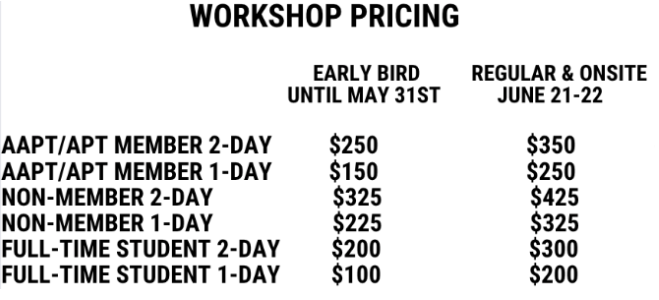





















 Alabama Association for Play Therapy