

June 21-22, 2024 in Birmingham, AL
Lifeline Children’s Services 200 Missionary Ridge, Birmingham, AL 35242
Attendees will be able to select either one-day (Friday only or Saturday only) or two-day (Friday and Saturday) registration.

Conference Schedule
All times are CST
Friday, June 21, 2024 (6 contact hours)
| 8:00-8:30 | Registration |
| 8:30-11:45 | Tammi Van Hollander – Attachment-Based Play Therapy for Trauma, Behavioral & Sensory Challenges |
| 11:45-1:00 | Lunch on your own (AAPT Member Meeting – 12:45-1:00 – All are welcome!) |
| 1:00-4:15 | Tammi Van Hollander – Attachment-Based Play Therapy for Trauma, Behavioral & Sensory Challenges cont’d |
| 8:00-5:00 | Exhibits Tables Open |
Saturday, June 22, 2023(6 contact hours)
| 8:00-8:30 | Registration |
| 8:30-11:45 | Pre-selected Breakout Sessions |
| 11:45-1:00 | Lunch on your own |
| 1:00-4:15 | Tammi Van Hollander – Resilience through Sandtray Play Therapy: A Reflective Workshop |
| 8:00-4:45 | Exhibits Tables Open |
Registration Information
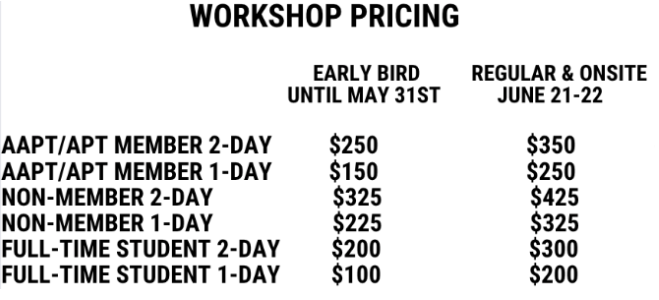
If you desire to register a group, please email ceandregistration@alabamaplaytherapy.org
Cancellations:
Registrants canceling up to 48 hours before the conference will receive a tuition refund less a $20 administrative fee. All requests must be made in writing or by email. No refunds issued for any reason after June 18. In the unlikely event, the conference cannot be held, registrants will receive a full-value voucher, good for one year, for a future workshop.
Accommodations, Special Needs, or Registration Questions:
Please contact CE & Registration at ceandregistration@alabamaplaytherapy.org
Scholarships
Scholarships to attend the AAPT workshop will be offered to full-time students who volunteer to be available Thursday evening, June 20th, all-day Friday, June 21st, and all day Saturday, June 22nd to assist with the conference. Volunteer duties may involve working registration, assisting with setup prior to the event, cleaning up after the event, selling books for the presenter, and preparing materials for the workshop. Students interested in volunteering for the event should contact Dorian Bayles at studentrep@alabamaplaytherapy.org and submit proof of enrollment in a counseling or related program (SW, MFT, CMHC, etc).
Session Information
PLEASE NOTE-For those planning to attend Saturday Only or both Friday and Saturday, you will need to pre-select which Saturday Breakout Session you will be attending.
Friday, June 21- 6 CE
Attachment-Based Play Therapy for Trauma, Behavioral & Sensory Challenges
Tammi Van Hollander LCSW, RPT-S™
Overview:
This workshop will give you a clear understanding of the impact of attachment theory, attachment ruptures and how to heal these attachment wounds by creating safety and connection both inside and outside of the playroom. All behaviors have a meaning, so let’s meet our clients with curiosity and shift from a place of changing the behaviors to a place of understanding what is happening below the surface. When we meet children where they are and trust the process, we create a trusting and therapeutic relationship where then, change can occur. Tammi’s work is grounded in Dr. Bruce Perry’s, three R’s: regulate, relate, and reason.
Through creative sandtray work and attachment-based play therapy activities, we can deepen our understanding of our clients and their families from a neurobiological lens to strengthen their awareness of their behaviors and increase their resilience and self-esteem. This workshop will demonstrate how to both integrate play therapy theories and the Therapeutic Powers of Play into your work by incorporate creative strategies including sandtrays, bibliotherapy, mindfulness, and other expressive arts therapies through active learning and hands-on exploration. Play therapists and their mental health colleagues will leave with a toolbox filled with ready-to-use activities that they can implement immediately in daily practice with children, and also adapt for work with clients of all ages. Get ready to learn and have fun!
Learning Objectives:
1) Demonstrate at least 5 attachment-based -based play therapy activities that act as a co-regulator, bringing the brain and body into the therapy experience.
2) Describe 4 play therapy techniques that can be used to form healthy attachments, attunement, and repair trauma in the children you work with
3) Discuss the efficacy of using play therapy in nature and how you can bring nature-based activities into your playroom.
4) Identify 3 ways sandtray play therapy can quiet a child’s nervous system when child is in a dysregulated state.
5) Characterize how play therapy can reframe trauma experiences, increase self-regulation and connect to a mind/body awareness.
6) Summarize the polyvagal theory and learn how psychoeducation of neurobiology can deepen the healing work of our clients.
7) Decipher at least 3 indicators when to use a bottom-up approach and when top-down strategies are beneficial.
Saturday (AM), June 22 – 3 CE
Attendees will select one (3hr) or two (1.5 hr) break-out sessions on various topics.
Breakout Sessions
ALL MORNING OPTION (8:30-11:45) – 3 CEs
Breakout #1 (Supervision) Deepening Your Play Therapy Supervision with Sandtray
Tammi Van Hollander LCSW, RPT-S™

Overview: Join us for an enriching 3-hour sandtray supervision workshop designed to elevate your supervisory skills. This hands-on session will walk you through the process of creating a safe and supportive space for your supervisees to engage in sandtray therapy effectively. Explore advanced techniques to deepen your supervisory relationships and facilitate more profound discussions about client cases. You’ll discover how to cultivate secure environments that promote open and authentic dialogue while effectively managing potential challenges and conflicts. Enhance your competencies in sandtray therapy, gaining a deeper understanding of its theoretical underpinnings and practical applications. Whether you’re an experienced sandtray supervisor or just embarking on your supervisory journey, this workshop provides a unique opportunity to hone your skills, increase self-awareness, and elevate your supervisory practice. Don’t miss this chance to unlock the full potential of sandtray supervision and empower your supervisees to become more effective and empathetic therapists.
Learning Objectives:
1. Identify three benefits of using sandtray in play therapy supervision.
2. Describe a rationale for using sandtray in the process of case conceptualization in play therapy supervision.
3. Describe 2 sandtray interventions to utilize in play therapy supervision.
4. Participants will learn advanced techniques and strategies to enhance their supervisory skills in the context of sandtray therapy
5. Participants will practice effective methods for promoting self-awareness and self-reflection in both
themselves and their supervisees, leading to more meaningful supervision experiences.
FIRST SESSION OPTIONS (8:30-10:00) 1.5 CEs
Breakout #2 (Ethics) Legal and Ethical Considerations When Counseling Children
Robyn Trippany Simmons, Ed.D., LPC-S, RPT-S™ & April Morris, MS, ALC

Overview: In counseling children, it is critical for the clinician to be aware of specific ethical considerations and legal issues in working with minor clients. The focus of this workshop will be working with children and families in an ethically responsible manner.
Learning Objectives:
1. Analyze ethical issues that are unique to working with children (i.e., documentation, competence, informed consent, confidentiality, cultural competence, boundaries, etc…) in the play therapy environment.
2. Apply ethical decision making processing to ethical concerns that arise in play therapy
3. Identify legal requirements and limitations of working with minor clients in play therapy.
__________________________________________________________________________________________________
Breakout #3 (Play Therapy Skills and Methods) Paradoxical Approaches in Play Therapy: “Failing” to Succeed
Darrell R. Manning, MS in Clinical Psychology, LPC-S, EMDR Trained, EAP Specialist, Certified Gambling Addiction Counselor
Overview: The presentation will focus on play therapy principles and techniques that encompass paradoxical approaches designed to facilitate healing in several areas of concern, including trauma, parenting techniques, crisis intervention techniques and reframing/story telling for building resilience/coping skills.
Learning Objectives:
1. Learner will be able to verbalize at least 4 of the principles of Paradox for play therapy
2. Learner will be able to identify 4 areas of techniques to enhance the therapeutic process in play therapy in general
3. Learner will be able to verbalize 3 specific areas and the techniques to enhance healing in these areas.
__________________________________________________________________________________________________
Breakout #4 (Play Therapy Skills & Methods) Play Therapy for Distressed Adult Clients
Shu-Ching Wang, LPC, RPT™ & Yuh-Jen Guo, LPC, RPT™

Overview: When clients become hypervigilant and distressed, their ability of cognitive processing is limited. Play activities can be used to help clients return to a calm and regulated state. This presentation will introduce several play activities that can be used in sessions to assist clients overcoming distressful situations.
Learning Objectives:
1. Audience will learn the application of play therapy and other theoretical concepts for calming and self-regulation in distressful time.
2. Audience will practice the play activities of play therapy to learn how to implement them in sessions.
3. Audience will discuss their experience in practicing these play activities and how they will use play therapy and play activities in their clinical practices.
SECOND SESSION OPTIONS (10:15-11:45) 1.5 CEs
Breakout #5 (Play Therapy Cultural and Social Diversity Topics) ASL Interpreters in the Play Room
Teresa Powers, MS, LPC, RPT™

Overview: We are currently experiencing a mental health crisis for children and youth which is even more true for those who are Deaf or hard of hearing. This workshop will introduce clinicians to key linguistic and cultural considerations. We will explore various forms of culturally appropriate play therapy as well as experiencing some activities ourselves. We will also discuss the implications and role of the interpreter in the play room.
Learning Objectives:
1. Discuss the needs of play therapy for Deaf and Hard or Hearing Children.
2. Identify the interpreter’s impact on the Play Therapy Relationship.
3. Compare 3 key cultural differences between Hearing and Deaf culture and how to create a culturally inclusive play therapy space.
__________________________________________________________________________________________________
Breakout #6 (Play Therapy Seminal or Historically Significant Theories, Play Therapy Special Topics)– Not One Size Fits All: Using Curative Factors of Change in Play Therapy Effectively
Danyale Weems, LCSW, RPT-S

Overview: Play Therapist need to be skilled in numerous therapeutic arenas. Knowing how to communicate play into documentation and with caregivers is essential to treatment outcomes. Participants will deepen their understanding of Therapeutic Powers of Play allowing them to be more effective in meeting client’s needs.
Learning Objectives:
1. Participants will identify how the use of Therapeutic Powers of Play translates in play therapy documentation.
2. Participants will describe how to combine at least 2 Therapeutic Powers of Play in play therapy.
3. Participants will be able to describe how use of Therapeutic powers of play are grounded in Integrated play therapy.
__________________________________________________________________________________________________
Breakout #7 (Play Therapy Skills and Methods, Play Therapy Special Topics)– To Be Directive or Non-directive? Using the Play Therapy Dimensions Model to Navigate Play Therapist Involvement
Connie Couch, PhD, LPC, and Daniel Birdsong, PhD, LPC-S, RPT

Overview: Have you ever felt lost and asked yourself if you should you use a directive intervention or stick to a child-centered approach? Let’s explore The Play Therapy Dimensions Model, which was developed to help therapists determine how to respond to choice-points in session based on the client’s level of awareness.
Learning Objectives:
1. Attendees will be able to define the use of the PTDM as an organizing framework for integration of play therapy approaches.
2. Attendees will be able to explain at least two ways that the PTDM can guide decision-making about directiveness in play therapy sessions.
3. Attendees will be able to explain the differences between the four quadrants of the PTDM and give at least 1 example of therapist behaviors in each quadrant.
__________________________________________________________________________________________________
Breakout #8- (Play Therapy Skills and Methods, Play Therapy Special Topics)-Self-Injurious Behaviors: Supporting Empathy and Effective Treatment in Play Therapy
Dana Wyss PhD, LMFT, ATR-BC
Overview: This workshop is an inspiring exploration of the impact that self-injury has on individuals, their families, and service providers. Through art and play-based activities and discussion this workshop aims to raise support for ourselves, individuals and the families at a time when they often feel the least connection to others.
Learning Objectives:
1. Identify several types of Self-Injury
2. Identify how to differentiate warning signs and risk factors for different clients
3. Name 3 things to say and/or do to foster the therapeutic relationships for someone who is currently at risk for self-injury
4. Be able to practice 3 ways Play Therapist can provide nonverbal support to increase self-expression and creative problem solving for someone who is engaging in self-injurious behavior
Saturday (PM), June 22 – 3 CEs
Play Therapy: Reflection and Resiliency in the Sandtray
Tammi Van Hollander, LCSW, RPT-S™
Let’s dive deeper into sandtray play therapy and experience how therapists and our clients can use sandtray play therapy as a tool for reflection and resiliency when words are not enough. Sandtray play therapy offers a place for grounding in the body, promotes curiosity and can reveal deep discoveries of self. This workshop will incorporate The Nurtured Heart Approach©, which is an attachment-based model to honor and celebrate the greatness of our most difficult clients, increase their self-esteem, and boost their resilience. Participants will learn how to use Greatness Cards© and Greatness Sticks © in the sandtray with individuals and families to shift from a negative lens to a positive lens. When we can reframe how we look at these intense clients, our approach changes and that is when the healing can occur. This 3-hr workshop will include case studies, experiential activities, video demonstrations, both group and personal sandtray creations, grounded in the Therapeutic Powers of Play, Attachment Theory, and Neuroscience and The Nurtured Heart Approach©. Other greatness play therapy activities will be introduced outside of the sandtray incorporating the different therapeutic powers of play. This workshop will give you the confidence to work with the most challenging of children and move you to a place of curiosity and compassion through these play-based activities. Both beginner sand therapists and seasoned sand therapists will gain new information to creatively expand their therapeutic work.
Objectives
1. Understand the neurobiological effects of trauma in sandtray therapy and apply 3 trauma processing
techniques in the sandtray process.
2. Utilize sandtray therapy to enhance family connections and strengthen relationships, implementing 3 key strategies.
3. Integrate the Nurtured Heart Approach® into play therapy, explaining how it enhances resilience and self-esteem for children and families, while applying at least 3 play therapy interventions.
4. Demonstrate 4 play-based interventions to build resilience in children, teens, and families, grounded in
theoretical constructs that encourage attachment and resiliency.
AAPT Blankets for Sale
Pick up will be at the Conference Registration Table

Core Fleece sweatshirt blanket 50/50 blend 50×60” with AAPT imprint 6×7” $30
CE Information
Contact Hours will be awarded for each full day of attendance. No partial credit will be awarded.
Counselors: Alabama Association for Play Therapy (AAPT) has been approved by NBCC as an Approved Continuing Education Provider, ACEP No. 6211. Programs that do not qualify for NBCC credit are identified. Alabama Association for Play Therapy is solely responsible for all aspects of the programs.
Marriage and Family Therapists: The Alabama Board of Examiners in Marriage and Family Therapy (ABEMFT) automatically approves courses that are NBCC approved for CE credit.
Play Therapists: AAPT is approved by the Association for Play Therapy (APT) to offer continuing education specific to play therapy. APT Approved Provider No. 98-045.
Hotel Information

Homewood Suites by Hilton Birmingham-South/Inverness ($139 a night 6/20-6/23). Click on the “Book Your Room Now” below to be access the discounted rate!
215 Inverness Center Dr, Birmingham, AL 35242

Vendor Information
We hope you will consider being a vendor during this wonderful event. The vendor fee is $50, which includes one table and chair. Each additional table is $10. We request that each vendor also donate one raffle gift per day (two total).
Some important information to keep in mind:
- The conference venue will be Lifeline Children’s Services-200 Missionary Ridge Birmingham, AL 35242
- Set-up for exhibitors is Friday, June 21 from 7:30-8:30 AM
- Take down for exhibitors is Saturday, June 22 from 4:45-5:15 PM
- AAPT Exhibit Area hours are Friday June 21 & Saturday June 22 8:00 AM-4:45 PM
- Your image-ready logo (JPEG or PNG) and business description will be shared with attendees in advance.
Email treasurer@alabamaplaytherapy.org if you have any questions or need any additional information.
APT Membership information
Want to save on your registration and you aren’t a member of the Association for Play Therapy, consider joining today!

Visit https://www.a4pt.org/page/Membership
Accommodations, Special Needs, or Registration Questions:
Please contact CE & Registration at ceandregistration@playtherapyalabama
For Conference Questions:
Contact AAPT President-Elect Angela Mains at (205)940-4621 or email her at pres-elect@alabamaplaytherapy.org
 Alabama Association for Play Therapy